


Special Educational Needs and Disabilities (SEND)
At St Mary’s C of E VA Primary, we are ambitious for all our pupils. It is our intention that, irrespective of their background or the challenges they face, every child is given the best the possible chance to maximise their potential. We strive to ensure all pupils flourish in our inclusive, supportive and caring school in order to be the best they can be.
At St. Mary’s we endeavour to raise the aspirations and expectations for all children with SEN, providing a focus on outcomes. We believe in providing every possible opportunity to develop the full potential of all children. Pupils have the right to a broad and balanced education where their individuality is valued, and their self-esteem promoted. We work in close partnership with parents/carers, Governors and the wider community. The children grow and develop as we prepare them for the challenges of education, work and life enabling to succeed now and in the future.
At St Mary’s, inclusion is at the heart of everything we do:
“This caring community recognises that to be fully inclusive, support must break down barriers so pupils flourish alongside peers.”
“Leaders create a culture where pupils and staff flourish together. Aspiration is promoted and seen in action.”
SIAMS Inspection (2025)
Meet the Inclusion Team
At St Mary's, inclusion is driven by all members our community but at the heart is our inclusion team:
Inclusion (ID 1576)
-
Elisa VindelInclusion Lead
Elisa Vindel
-
Emma WilkinsonSENDCo
Emma Wilkinson
-
Jane CowellPastoral Lead
Jane Cowell
Accessibility_PlanSEND Parent Information Report
Parent Information Report (2025 - 2026)
Our Special Educational Needs Report illustrates what we offer at St Mary’s to our children and young people with special educational needs.
Types of SEND we support are:
The Code of Practise identifies four main categories of need, and these are:
Communication and Interaction
Children and young people with speech, language and communication needs (SLCN) have difficulty in communicating with others. This may be because they have difficulty saying what they want to, understanding what is being said to them or they do not understand or use social rules of communication. The profile for every child with SLCN is different and their needs may change over time. They may have difficulty with one, some or all of the different aspects of speech, language or social communication at different times of their lives.
Children and young people with ASD, including Asperger’s Syndrome and Autism, are likely to have particular difficulties with social interaction. They may also experience difficulties with language, communication and imagination, which can impact on how they relate to others.
Cognition and Learning
Support for learning difficulties may be required when children and young people learn at a slower pace than their peers, even with appropriate differentiation. Learning difficulties cover a wide range of needs, including moderate learning difficulties (MLD), severe learning difficulties (SLD), where children are likely to need support in all areas of the curriculum and associated difficulties with mobility and communication, through to profound and multiple learning difficulties (PMLD), where 5 children are likely to have severe and complex learning difficulties as well as a physical disability or sensory impairment.
Specific learning difficulties (SpLD), affect one or more specific aspects of learning. This encompasses a range of conditions such as dyslexia, dyscalculia and dyspraxia.
Social, emotional and mental health difficulties
Children and young people may experience a wide range of social and emotional difficulties which manifest themselves in many ways. These may include becoming withdrawn or isolated, as well as displaying challenging, disruptive or disturbing behaviour. These behaviours may reflect underlying mental health difficulties such as anxiety or depression, self-harming, substance misuse, eating disorders or physical symptoms that are medically unexplained. Other children and young people may have disorders such as attention deficit disorder, attention deficit hyperactive disorder or attachment disorder.
Sensory and/or physical needs
Some children and young people require special educational provision because they have a disability which prevents or hinders them from making use of the educational facilities generally provided. These difficulties can be age related and may fluctuate over time. Many children and young people with vision impairment (VI), hearing impairment (HI) or a multi-sensory impairment (MSI) will require specialist support and/or equipment to access their learning, or habilitation support. Children and young people with an MSI have a combination of vision and hearing difficulties.
(SEND Code of Practice, January 2015. P97)
SEND Provision at St Mary's:
We provide all pupils with a fully inclusive approach to school life, whether this is within the classroom, at lunch or within extra-curricular activities. We pride ourselves on providing quality first teaching to all pupils.
We currently offer the following for pupils with SEND:
Universal Support:
Inclusive, Quality First Teaching (QFT) for all pupils. This also includes appropriate differentiation and other changes that will enable pupils to access whole class teaching. This may include environmental changes, accessibility of resources, peer and/or adult support, alternate methods to recording working, scaffolds (tools and resources to support learning and completion of work) or strategies to promote independency.
Quality First Teaching means:
- The teacher has high expectations of every child in their class
- Teaching and learning builds on from what every pupil already knows, is able to do and understands
- Lessons are appropriately differentiated (adapted) so that all pupils can access learning
- Where necessary, specific strategies to support your child to learn
- On-going assessment to monitor progress and to identify any gaps in learning or understanding
- Any particular needs or support is swiftly identified, planned for, carried out and then reviewed (see below ‘Graduated Approach’)
Targeted Support:
- All children have access to our universal support as outlined above. However, where a particular need has been identified, the approach to your child’s teaching and learning may become more personalised and their support may become more targeted. This could include small group adapted work and short-term focused interventions.
SEND Support:
- If a child is receiving universal and targeted support and not making the expected progress, an increasingly individualised SEND programme will be considered by the Inclusion Team alongside the class teacher.
- This may include individual or small group adult-led targeted support. All interventions are monitored and reviewed to ensure the expected impacted and progress has been made.
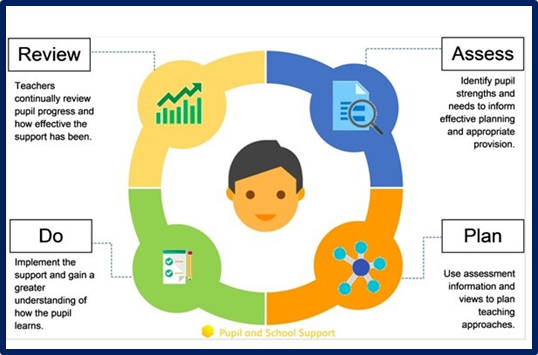
- At St Mary’s School, all our teachers follow the four-step cycle of Assess, Plan, Do and Review. This structure allows us to continuously assess children’s learning and progress, plan for next steps or additional provision (such as targeted interventions), carry out what we planned to do and continuously review for impact and progress. This cycle is continuously followed to ensure all children achieve. As parents, we will update you with progress and ensure you are part of your child’s educational journey every step of the way.
- During this process, the class teacher with liaise with parents, the child, SENCo and Pastoral Lead. The SENDCO may seek external agency advice where appropriate.
What did OFSTED and SIAMs say about SEND at St Mary's?
In the past year, our school has been reviewed by both SIAMS and Ofsted. We encourage you to explore their feedback below to see how we support children with Special Educational Needs and Disabilities (SEND).
SIAMs - Church School Inspection:
“There is substantial provision for vulnerable pupils and those with special educational needs and/or disabilities (SEND). Parents speak movingly about the support given to their children. Leaders go above and beyond to meet pupils’ needs. Examples include knowing when pupils require extra time before going into the classroom, so they are ready to learn. This caring community recognises that to be fully inclusive, support must break down barriers so pupils flourish alongside peers. Curricular and extra-curricular activities in creative arts offer opportunities for learners of all abilities to excel. The school’s pastoral team works tirelessly to assist pupil wellbeing and academic progress.”
OFSTED:
“The school has strengthened how it identifies and supports pupils with special educational needs and/or disabilities (SEND). In most subjects, the curriculum is adapted well to ensure that pupils’ individual needs are met. However, this is not consistent. Some pupils with SEND do achieve as well as they should”.
Frequently asked Questions:
To help you better understand inclusion and SEND provision at St Mary’s, we invite you to explore the frequently asked questions below. If you still have any queries, please don’t hesitate to email us at stmarysthornbury@sgmail.org.uk.
What should I do if I am concerned my child has Special Educational Needs?
In the first instance speak with your class teacher and share your concerns.
How will St Mary's school know if my child has Special Educational Needs?
If your child has already been identified with SEND and has transferred to us, we should have received information from their previous setting and any external agencies already involved. Please ensure you have arranged a meeting with the SENDCo to discuss your child’s needs prior to starting with us.
If your child is already attending our school, we identify children with SEND through continuous assessment. Teachers will not only continuously assess your child’s academic achievements, but will closely observe their personal, emotional and social ones too. Through regular monitoring by the schools Senior Leadership Team and discussion with the SENDCo, any concerns are highlighted and steps put in place to identify if additional support is needed. These will always be discussed with both parents.
What will happen if my child is identified as having Special Educational Needs?
The class teacher will meet with you to discuss the areas of need and, with your agreement, create a plan of support for your child. This might include:
- Differentiated learning approaches and resources
- Environmental or physical adaptations
- Additional or targeted support
Referral to external agencies
How will the school monitor and evaluate my child's progress?
We have high aspirations for all our pupils, including those with SEND. We expect every pupil, regardless of their starting point, to make progress within each academic year.
Progress will be monitored by:
- Formal assessments
- Analysis of pupil progress data
- Review of interventions/support
- Feedback from parents and pupil
- SENDCo reviewing provision for pupils with SEND and evaluating its intended impact
- Review of set within Support Plans and EHCP’s (Educational Health Care Plan) where necessary.
How will the school work in partnership with families?
At St Mary’s we have an open-door approach. A member of the Inclusion Team is always visible on the playground before and after school. Each class has a dedicated email address which supports communication between home and the class teacher. In addition to this, we:
- Hold Support Plan meetings which are held 3 times a year, where targets are reviewed and news one set
- Have Parents evenings which are held in Autumn and Spring Terms
- Produce end of year written reports which are shared in the Summer Term
- Hold Parent workshops which run through the year
- Direct parents to local and national resources
How will my child's voice be heard?
At St Mary’s we understand the importance of not only listening a child’s voice but also ensuring that they feel they have been heard. Pupils’ voices are gained throughout the year; theses are formally recorded on their support plans and form part of the target setting.
How will teaching staff know about my child's needs and provide the right kind of support?
- Information about your child and his/her particular needs will be shared with all teaching staff
- All staff will receive ongoing training
- All teaching will be based on the Quality First Teaching model
- All teachers will be involved in regular assessments and reviews of all pupils and their provision.
- The SENDCo will work closely with class teachers to ensure the correct provision is in place for all pupils with SEND.
When transitioning to a new year group, your child’s previous class teacher will meet with their next class teacher to ensure all relevant and necessary information is shared.
How will the school curriculum and learning environment be adapted for my child?
We believe that all pupils should have access to the full National Curriculum. As outlined in ‘universal support’, reasonable adjustments and necessary differentiation is part of Quality First Teaching for all pupils. Class teachers with adapt and differentiate their planning and teaching to ensure all children in the class are able to access the lesson and make progress. At times, learning outcomes may be adapted for individuals or small groups of children.
Classroom environments have been designed to ensure that distractions are minimal and resources are accessible to all.
If my child has Special Educational Needs and/or a disability, will they have access to all of the activities on offer at the school?
We strongly believe that our school should be inclusive for all pupils. We will do everything we can to ensure that your child is able to participate fully in all aspects of school life. All reasonable adjustments will be made to ensure your child has full access to all activities offered by the school.
Which external agencies for the school work with?
- Educational Psychology Service
- Inclusion Support
- Behaviour Support
- Speech and Language Support Services
- Occupational Health
- Physiotherapy
- School Nursing Team
- CAMHS
- Paediatricians
- GP
- Specialist teachers (hearing and vision)
- Social Care
How does St Mary's support children transitioning between education providers and with moving on to their new year group?
Pre-School to St Mary’s
Class teacher visits pre-schools. If a child is already identified as having special educational needs, the SENDCo will accompany the class teacher. A meeting with be held with pre-schools to ensure all information is passed over. An additional meeting with parents will also be held. Further visits may be arranged, depending on the need.
Transitions from year groups within school
Current teacher will meet with new teacher in the Summer Term to share information. Support Plans and one-page profiles are passed over, along with resources. Transition booklets are provided to support children who will benefit from visual reminders of their new class over the summer.
St Mary’s to Secondary
The class teacher and SENDCo will meet the secondary school SEND team to share information on the child. Enhanced transition support will be applied for when necessary, however, this allocation is decided by the secondary school. Named secondary schools will be invited to the Annual Review held in Year 5/6 for children who have an EHCP.
Mid-year transfers
If your child has already been identified with SEND and has transferred to us, we should have received information from their previous setting and any external agencies already involved. Please ensure you have arranged a meeting with the SENDCo to discuss your child’s needs prior to starting with us.
My child has an ongoing and long-term medical condition. How will St Mary's School support him/her?
It is essential that parents and school meet to discuss your child and their medical condition. Together, we can identify any potential barriers or risks and put a suitable plan in place. This plan will be monitored regularly and reviewed with yourself.
Who can I contact for further information or to discuss any concerns I may have about the SEND provision for my child?
We are always very happy to talk to parents and listen to any concerns they may have. If you have any worries or concern about school or how we are providing for your child, please talk to your child’s class teacher initially. We will always do our best to respond to concerns raised with us. If you are still concerned about the support for your child, please speak to the SENDCo in the next instance.
If after this step, your concerns remain unanswered, an appointment can be made with the Acting Headteacher via the school office - stmarysthornbury@sgmail.org.uk.
Alternativley, if you feel that your concerns are not being responded to, school has a formal complaints procedure which can be found on the school website, or it can be requested from the school office.
The LOCAL Offer
The purpose of the SEND local offer is to provide information in one place, offering ongoing support to children and young people with Special Educational Needs and Disabilities and their families across South Gloucestershire. The SEND local offer describes what help, support and services are available in the local area. The SEND local offer website includes information on services and support from South Gloucestershire Council, its partners and community and voluntary groups across education, health and social care.
South Gloucestershire Council’s Local Offer can be found by visiting:
Further Links and Support:
For further support and guidance, you may find the links below helpful. Alternatively, you can visit:
SEND and YOU
SEND and You was originally set up as a charity in Avon in 1989 by local parents and professionals. They’d realised that better outcomes could be achieved for children and young people with SEND by working together. Today we remain as responsive and firmly focused as ever, ensuring that children, young people and their parents or carers get the help they need. SEND and You was formerly named Supportive Parents.
SEND and You now delivers the ‘SENDIAS’ (Special Educational Needs & Disability Information Advice & Support) service for three local authorities; Bristol, North Somerset and South Gloucestershire.
JIGSAW
JIGSAW Thornbury is a charity that works with all children and young people with additional needs or disabilities, and their families. We provide friendship, support, compassion and fun, along with innovative services that empower them to connect, fit in and thrive. Everything we do is driven by the passion of our staff and volunteers.
As well as being life changing for the young people and families we assist, our services are invaluable for the wider community too. We enhance inclusion by helping everyone understand the challenges that those with additional needs face and the unique strengths and qualities they bring.
School Nursing Team
School Nurses work with children, young people, and their parents/carers to maximise their health and well-being. School Nurses can meet with children and young people in groups, for example in school, or individually in several venues such as at school, at home or another venue in your local community. School Nurses provide information and support on several topics that children or young people come across that can affect their health.